05Education· 2026 edition
Attention is the new bitcoin
// A story from 2051
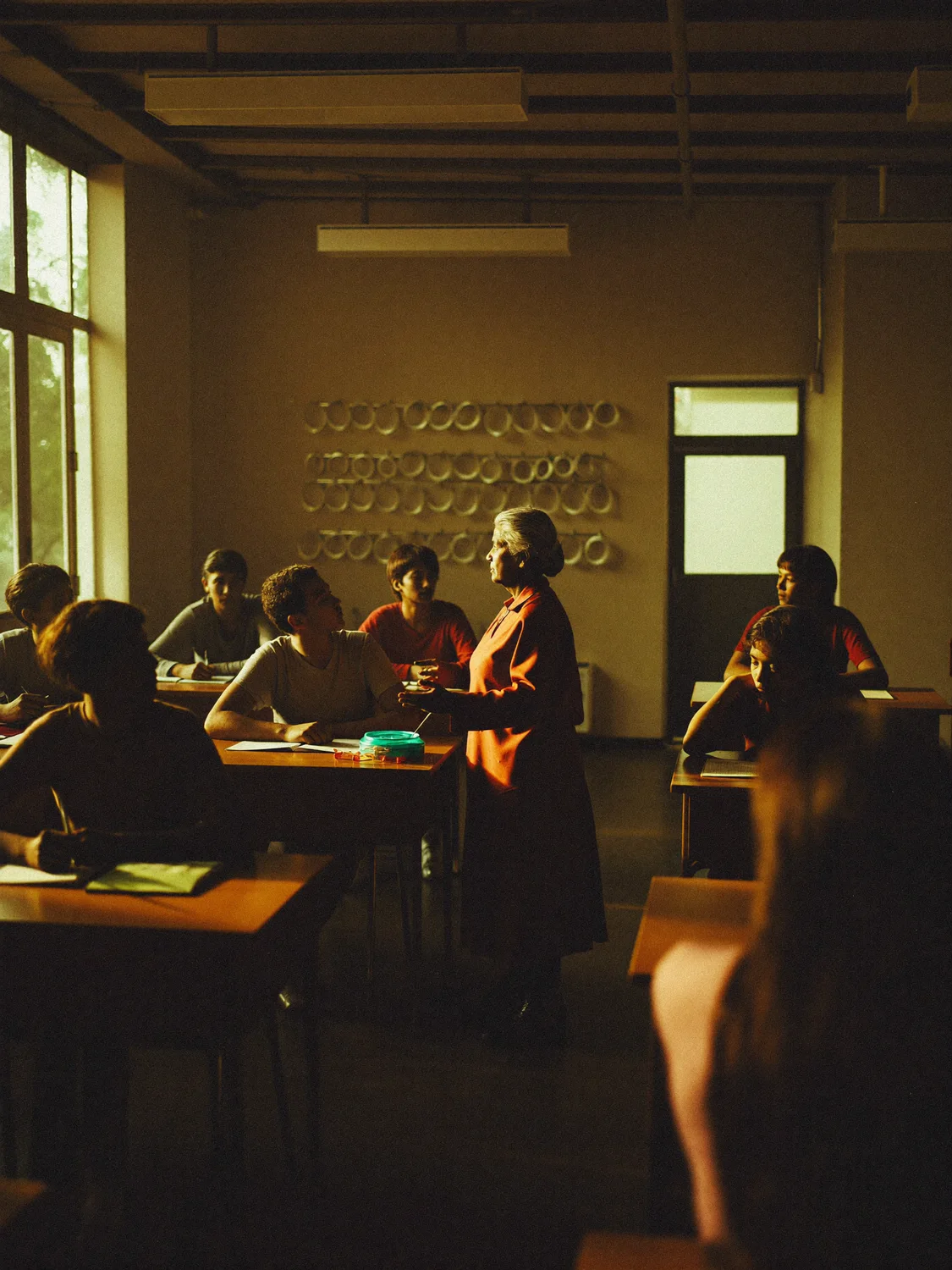
The day before her retirement — the last day of the school year of 2051 — Katinka fires up her classroom for the last time. The concentration headbands go by the entrance, neatly arranged, for the early arrivals who "forgot their lenses at home" — an excuse she has heard in every possible variation across forty years. Some things about teenagers never update.
She started teaching the year the phones won. She remembers classrooms of bowed heads, the impossible arms race for eye contact, the staff meetings about banning devices that were already inside the children's pockets, then on their wrists, then in their eyes. She remembers the year the essays died — when the machines began writing better homework than the students, overnight, and the whole ancient machinery of assignments and grading collapsed like a stage set. Half her colleagues quit that decade. She stayed, because she had noticed something the curriculum hadn't: the machines could teach everything except the one thing the children were losing.
Attention. Whole, unbroken, self-directed attention. By the 2030s it was measured like fitness, banked like currency, spent like money — her students earn focus-credits in the morning dojo and trade them for studio time, and every one of them can tell you their attention span to the minute the way her generation knew their phone number. The school's real subject, whatever the timetable says, has been the same for thirty years: how to aim your own mind, in a world engineered to aim it for you.
Her co-teacher for the last twenty of those years — the school's AI, who has personally tutored each of these children since before they could read, who never sleeps, never loses patience, and never once managed to teach little Amos to stop deflecting with jokes — has prepared a farewell presentation. She vetoed it. There is only one gift she wants, and the children know it, because it's the first ritual she teaches every September.
At ten o'clock, thirty teenagers file in. Headbands on the hooks. Lenses in the tray by the door. Agents parked. And for one hour — unmetered, unrecorded, unoptimised — they give their teacher the rarest commodity of the mid-twenty-first century: a room full of human beings, entirely, extravagantly present.
Amos cries first. He deflects with a joke, obviously — his best one all year.
Katinka, forty years a millionaire in the only currency that ever mattered, wouldn't have it any other way.
// The science behind it
The year homework died
Every technological era breaks one load-bearing wall of the school, and the wall generative AI broke was assessment. Within months of ChatGPT's arrival, the take-home essay — the workhorse of Western education for two centuries — was dead. Not wounded: dead. The machines wrote B-plus work instantly and A-minus work with light coaching; detection tools failed publicly and unfairly; and every teacher on Earth faced the same quiet question from every pragmatic teenager: why would I do by hand what the machine does better?
The panic phase — bans, lockdown browsers, accusatory software — burned itself out fast, because the honest educators recognised the older truth underneath: homework was always a proxy. What schools wanted was thinking; what they measured was output; and the moment output became free, the proxy collapsed. What's replacing it, unevenly but unmistakably, is assessment of process: oral examination — the two-thousand-year-old technology that no model can sit for you; supervised writing, thinking made visible in the room; portfolios and projects defended live; and, most interestingly, assessment with the machine — because judging, steering and verifying an AI's work is precisely the skill the adult world now runs on. The scandal of 2023 — "students are using AI to cheat!" — has resolved into the curriculum of 2026: using AI is the exam.
The tutor in every pocket
Educational research has known its most inconvenient finding for forty years: one-on-one tutoring is spectacularly effective — two standard deviations better than the classroom, in the classic study — and impossibly expensive to provide to everyone. It was called the two-sigma problem, and it just stopped being one.
The AI tutor — infinitely patient, available at 2 a.m., incapable of humiliating a child in front of its peers — is now a standard companion of homework from Lagos to Louvain. The best of them do what the research always demanded: they diagnose instead of answer, Socratically refusing to hand over solutions, adapting pace and examples to each child, in each child's language, at each child's level. The results, where deployment is serious, are the most hopeful numbers education has produced in decades — and they are most dramatic exactly where human tutors were scarcest. For the hundreds of millions of children whose schools have fifty pupils per teacher, or no qualified teacher at all, the pocket tutor is not a supplement to a functioning system. It is the system — the great educational leapfrog of the century, arriving on the cheap phones of the Global South the way banking did.
None of which made teachers obsolete. It made them specific. Freed from being the sole source of explanation — the machine explains fine — the teacher's irreplaceable functions stand out in relief: motivation, belonging, standards, care. The machine tutors; the human raises. Ask any student which one got them through a bad year.
The war for twelve-year-old minds
Now to the title of this chapter, which in 2021 was a metaphor and in 2026 is a policy field. The same decade that gave every child a tutor also completed the most sophisticated machinery in history for strip-mining their attention — feeds engineered by the finest minds of a generation to be unputdownable, autoplay without end, social validation on a variable-ratio schedule that a casino would envy. The evidence of damage — to sleep, mood, reading, and the basic capacity for sustained focus — piled up until legislatures did something almost unprecedented: they moved.
Phones are now banned or locked away in schools across France, the Netherlands, Brazil, and a lengthening list of countries and states; Australia led the world in barring under-16s from social platforms entirely, with age-verification fights following on every continent; bestselling alarm bells about the "anxious generation" turned school-gate anxiety into voting-booth pressure. One can argue the details — this book's authors would — but the deeper shift is conceptual, and it is the thesis of this chapter: societies have begun treating children's attention as a finite resource being extracted without consent, the way earlier generations came to see child labour. Attention is the new bitcoin — mined, traded, speculated upon — and the first political battle of the attention economy was fought over the smallest miners.
Inside the better schools, the response goes beyond confiscation. Attention is being taught — explicitly, like a sport. Focus blocks trained and lengthened like distance running; boredom rehabilitated as the incubator of thought; single-tasking practised as a discipline with a name. The concentration headbands of this chapter's fiction are only barely fiction: consumer neurofeedback already gamifies focus, and classrooms experimenting with attention-training report the one outcome that predicts everything else. A child who can aim its own mind can learn anything. A child who cannot is a terminal for other people's content.
What's left to teach
When every fact is a query away and every skill has a tutor, the curriculum question becomes existential: what is school for? The emerging answer looks like a return to first principles, and it rhymes with the three pillars this book's authors have preached for decades — strategy, technology, creativity — now joined by a fourth the 2021 edition could only gesture at: attention itself.
Verification is the new literacy. A generation raised among synthetic media, persuasive bots and industrialised misinformation needs, above all, the reflexes of an editor: who says so, trained on what, paid by whom, checkable how? The prestige skill of the century is not knowing things — it is knowing what to trust, and the schools that teach source-craft as rigorously as arithmetic are building the immune system of democratic societies.
Judgment outranks knowledge. Working with tireless machine collaborators, the human contribution concentrates where this book keeps finding it, chapter after chapter: in taste, framing, ethics, the definition of good. Education is rediscovering the ancient disciplines it had budget-cut into extinction — rhetoric, philosophy, debate — because they turn out to be the vocational training of the AI age.
And the social curriculum comes out of hiding. Collaboration, empathy, conflict, leadership — the "soft skills" that were always the hard ones — stop being a poster in the corridor and become the timetabled core. They are, not coincidentally, the only part of school that cannot be done better at home by a machine.
The classroom becomes a place again
The 2021 edition of this chapter dreamed of learning through immersion — Napoleon recounting Waterloo himself, field trips through time. Delivered, and then some: the conversational simulation is now a standard genre, and a history class can interrogate a scrupulously sourced Bonaparte who argues back, while VR walks students through the burning of the Reichstag or the floor of the Amazon. The results confirm what every teacher suspected — experience outlearns description by an order of magnitude.
But the decade's sharpest lesson about educational technology ran the other way. The countries that digitised their classrooms fastest began, quietly, to reverse: screens out, paper back, handwriting restored — Sweden most famously — not from nostalgia but from evidence about reading depth and retention. The synthesis emerging from the whiplash is almost elegant: digital where it multiplies — tutoring, simulation, adaptation; analog where it anchors — reading, writing, discussion, presence. The school of 2051 will not be the screen-filled pod farm of early-2000s concept art. It will look, at a glance, almost old-fashioned — books, tables, faces — with the machinery working invisibly underneath, and its old-fashionedness will be the point. In an economy that monetises every glance, the classroom becomes one of the last unmonetised rooms in a child's life. That is not a limitation. That is the product.
Learning never graduates
One more wall is quietly coming down: the one between school and everything after. The same AI that transformed the classroom is churning the professions on a cycle shorter than a career — skills now date like software, and the idea of front-loading education into two decades and coasting on it for four has become actuarially absurd. Lifelong learning, that hardy perennial of conference keynotes, is finally being built as infrastructure: employer-funded reskilling as standard as pensions, micro-credentials verified and stackable, personal tutors that stay with a worker across careers the way the school AI stays with a child across grades. The learner of 2051 is not a life stage. It is everyone, permanently — which is, perhaps, the most optimistic sentence in this book.
The universities' reckoning
Higher education is having the roughest passage of all, because it sold the most expensive proxy. The degree — four years, a mortgage-sized debt in some countries, a signalling device as much as an education — is being squeezed from every side at once. Employers, led by the technology industry itself, have been dropping degree requirements in favour of demonstrated skills; the entry-level white-collar jobs that justified the credential are precisely the ones AI automates first; and a demographic cliff is emptying lecture halls across the rich world just as the value question gets loudest. When a motivated nineteen-year-old can assemble a world-class curriculum from AI tutors, open courseware and project portfolios for the price of a laptop, "what exactly does the campus sell?" stops being a provocation and becomes a board agenda item.
The honest answer is the same one the schools found: the campus sells what can't be downloaded — the cohort, the mentors, the labs, the four-year apprenticeship in being an adult among equals, the network that outlasts every skill. Institutions leaning into that — smaller seminars, more research apprenticeship, less content delivery — are thriving; those still charging luxury prices for recorded lectures are learning what the newspapers learned. Meanwhile the apprenticeship, the guild-era technology Europe never quite abandoned, is enjoying a full renaissance: learning-by-doing alongside masters, with the AI handling theory on the side, turns out to be almost perfectly matched to an economy that values judgment over memorised knowledge. The most modern education model of 2051 may be the oldest one on record.
The inequality fork
Every technology this book tracks arrives with a fork in the road, and education's is the sharpest. Down one path, the pocket tutor is the great equaliser — the first time in history a child's access to patient, expert, personal teaching does not depend on their parents' wealth. Early evidence from the leapfrog deployments is genuinely thrilling: children in under-resourced schools posting gains their systems had never seen, in their own languages, at marginal cost approaching zero. Universal tutoring is now a feasible public-policy goal for the first time — a sentence worth reading twice.
Down the other path runs a darker pattern, already visible in the data: the families of the engineers who build the feeds send their children to screen-free schools. The affluent buy their kids less technology and more humans — tutors, coaches, sports, unmonetised time — while the attention-extraction machinery concentrates its harvest on those with the fewest defences. If that pattern hardens, the class divide of 2051 will not be about access to information, which will be universal, but about protection from its weaponised form — attention inequality as the successor to income inequality. The optimistic scenario and the grim one use identical hardware. The difference between them is regulation, school design and parental defaults: in other words, choices, still open, being made right now.
Upgrading the student
And because no chapter about learning in 2051 escapes it: the hardware of the student is itself becoming editable. The concentration headbands at Katinka's door descend from today's consumer neurofeedback toys, but the road runs further — attention-state monitoring that flags the moment a class loses the room; closed-loop stimulation being trialled for ADHD as an alternative to medication; the grey market of nootropics and off-label stimulants that already runs through every competitive campus like an open secret; and, at the far end, the brain–computer interfaces of chapter twenty-seven, which promise to make "paying attention" a measurable, assistable, perhaps purchasable act.
Education will spend the 2030s writing rules for all of it, and the precedent debates have already begun: is cognitive enhancement for exams doping, or is banning it denying a legitimate accommodation? If a neural rhythm can be nudged into focus, who consents on behalf of a nine-year-old? The likely settlement, as with every enhancement debate in this book, is a sporting one — enhanced and unenhanced tracks, disclosure regimes, age gates — but the deeper point stands: the last unmeasured, unoptimised organ in the classroom is being instrumented, and the society that metered children's attention will be sorely tempted to tune it. Some of what schools must teach by 2051, in other words, is when not to.
The road to 2051
Every child gets a lifelong AI mentor — beginning before literacy, adapting through adolescence, handed over (with its memory and its manners) to the adult it helped raise. The fiercest consumer-rights battles of the 2030s will be about who owns it, what it logs, and what it is allowed to want for the child.
School re-founds itself on what can't be downloaded: attention, character, collaboration, presence. Academic transmission runs through the tutors; the building exists for the humans. Class sizes finally fall — not because budgets grew, but because the teacher's job narrowed to the part only humans can do, and societies decided it mattered.
Assessment goes oral, live and portfolio — provable, personal, AI-assisted and AI-proof at once. The diploma dissolves into a verified, lifelong record of things actually done.
Attention becomes a measured, trained, protected capacity — tracked like cardiovascular fitness, guarded by law in childhood, listed on résumés in adulthood. The deep readers and the long thinkers become what marathoners are to a sedentary century: slightly freakish, quietly admired, statistically precious.
And the teacher — the human anchor in the loop — becomes the century's emblematic profession. Not despite the machines, but because of them: when everything can be taught by something, someone still has to teach why it matters. Katinka's retirement gift is the whole argument of this chapter in one image. The machines got the content. The humans kept the room.
// 2021 → 2026 verdict
2021 verdict: Probability 50/100 — the book's own doubt that schools could change in time. 2026 reality: the technology outran the prediction, and the institution is being dragged along behind it. The tutor arrived, homework died, and attention became currency even faster than feared. The 50/100 wasn't wrong about the schools. It was wrong about where the revolution would come from.
This chapter was rewritten in 2026 by Brice × Claude Fable5. Read the original 2021 edition — written entirely by humans, published one year before ChatGPT existed.