22DNA design· 2026 edition
Pimp my DNA
// A story from 2051
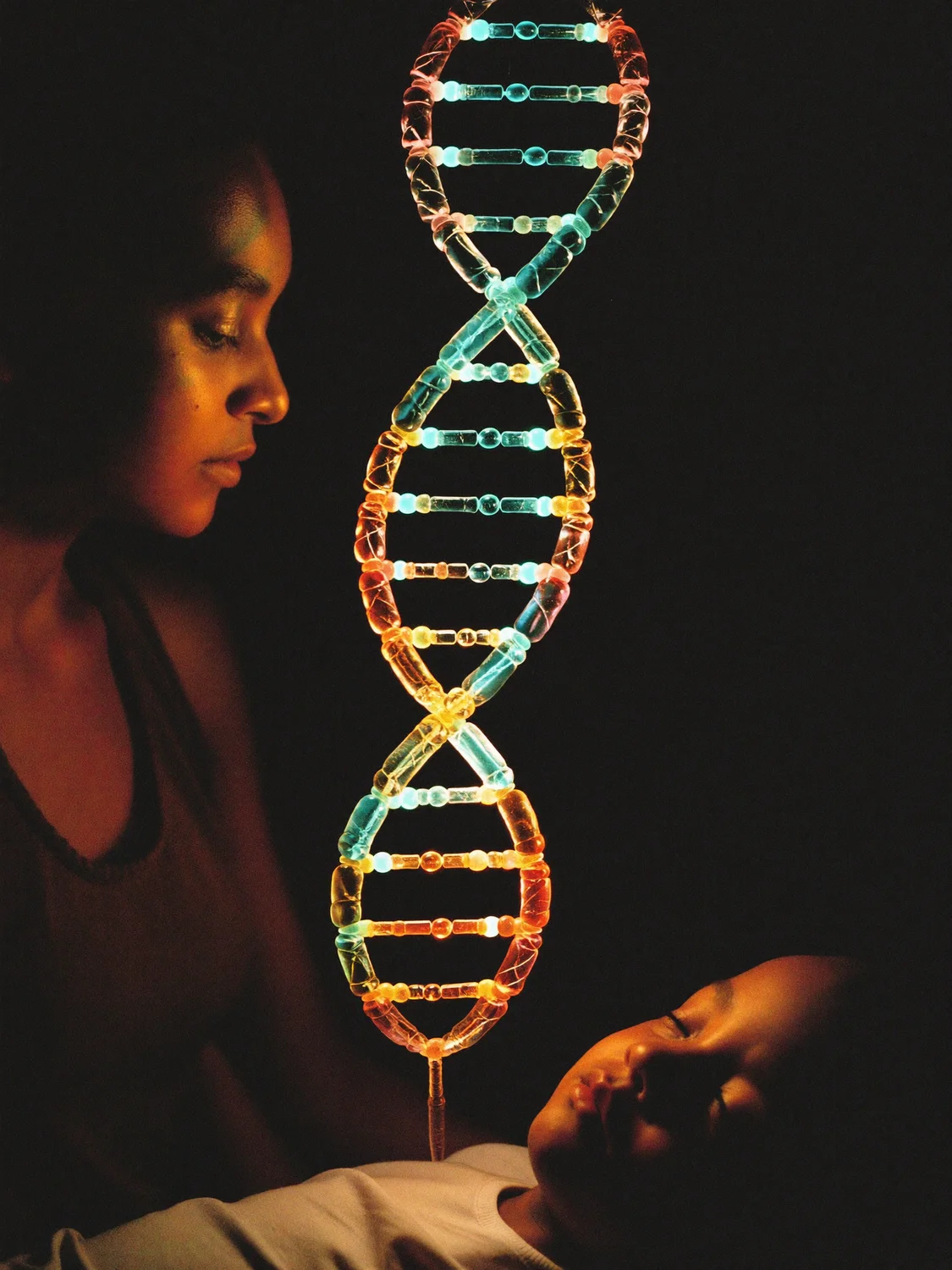
Stephen and Laila are the delighted future parents of Lani, a little boy, and today they are heading to the last prenatal appointment with their child's geneticist. Dr. Austin has been an angel since the beginning. Early in the pregnancy the foetus was not developing well — Laila carries the gene for sickle-cell anaemia — and there had been a bad few days of fear before the correction. Now there is nothing to worry about. The problem was caught, the necessary work was done, and the couple is preparing for a healthy child.
Both of them are endurance-sport fanatics, and so, while Dr. Austin was in there, they asked about a couple of other genes — ACTN3, ACE, the ones the running magazines talk about — that nudge strength and stamina. They tell themselves, and it is true, that they will let Lani choose whatever life he wants. They simply believe a strong, tireless body will help him choose it more freely. They try not to think too hard about the line they have just stepped over, because everyone they know has stepped over it, and it is hard to feel like a monster in a crowd.
Summer, 2051, Tahiti. Lani is five, brown and salt-crusted and tireless, meeting his friends for a swimming lesson at the surf school. He has already mastered the breaststroke; where the other children tire and quit, Lani tries and tries until he wins, and does not quite understand why the others stop. His parents know his genetic profile the way an earlier generation knew a child's shoe size — the exact proteins and nutrients each week, the vitamin B and C they add now that his love of the water is logged in his file. A chip in his shoulder streams his development to Dr. Austin, who checks in by holo-conference; no need for a lab. Everything is normal — better than normal, which is the whole point.
That evening, watching Lani sleep, Laila feels the old vertigo return. He is perfect, and he is theirs, and some part of what he is, they chose — from a menu, with a doctor, before he could say a word about it. She wonders what he will make of that when he is grown, in a world where the children whose parents chose more are pulling ahead, and the children whose parents chose nothing are falling behind. She kisses him, and does not have an answer, and neither, in 2051, does anyone else.
// The science behind it
The prophecy that came true in a hospital, on schedule
The 2021 edition of this chapter bet, at 90/100, that we were entering the age of directed human evolution — that gene editing would move from laboratory to clinic to, eventually, the nursery, curing disease and then enhancing traits. Of all the predictions in this book, this is among the fastest and most literally vindicated, and the proof is almost eerie. The fiction turns on a baby saved from sickle-cell anaemia by genetic intervention. In the real world, at the very end of 2023, regulators approved the first-ever CRISPR gene-editing therapy — and the disease it was approved to cure was sickle-cell anaemia. The exact scenario the original invented as a 2051 vignette became an approved medical treatment within two years of the book's publication. Gene editing is no longer coming. It arrived, in a hospital, curing the precise disease the fiction chose, on a timeline that outran the author's own imagination.
From one blunt cut to a molecular word processor
And it did not stop at that first cut. The 2021 essay described CRISPR as it then was — a tool that snips DNA at a target. In the years since, the toolkit became astonishingly more precise: base editing, which changes a single genetic letter without cutting the strand; prime editing, described as a molecular find-and-replace, a word processor for the genome. Then the frontier the fiction lives in was crossed for real: in 2025, doctors treated a newborn baby suffering from a fatal genetic disorder with a bespoke CRISPR therapy — a correction designed and manufactured specifically for that one child, in months. A custom edit, for a single infant, to fix a broken gene. Lani's Dr. Austin, catching a problem and performing "the necessary procedures," is no longer science fiction; the first real version of that doctor is already practising. And behind all of it runs the accelerant the original correctly named: artificial intelligence, now designing proteins and predicting edits (chapter six's revolution), turning genetic engineering from artisanal lab work into something increasingly computational. The essay's "pocket laboratories" — cheap, compact, democratised gene tools escaping the imposing institutions and reaching, eventually, the kitchen table — are half-arrived too: DNA sequencing collapsed in price toward the fabled hundred-dollar genome, benchtop editing kits proliferated, and a global "collective genetic consciousness" of shared databases and open protocols is real. Genetics did not stay locked in the cathedral labs. It is leaking, exactly as predicted, toward everyone — which is precisely what makes the ethical questions below so much harder to contain.
The chimera prophecy: pig hearts and human patients
The essay's strangest section — "the advent of chimeras," the mixing of human and animal biology — also came true, in the operating theatre. The decade saw the first transplants of gene-edited pig organs into human patients: hearts, and then kidneys, from pigs engineered to make their organs compatible with human bodies. This is precisely the human-animal genetic combination the original flagged, deployed for exactly the reason it predicted — to solve a desperate medical shortage, the shortage of organs for transplant. The "frowned-upon" frontier of borrowing from animal biology to extend human life is now a genuine, if still experimental, clinical reality. The chapter's science, section by section, has been vindicated with unusual completeness. Which makes its central warning — the one the fiction carries and the essay half-dodged — all the more urgent.
The line the original waved away: therapy versus enhancement
Here is where the 2026 telling must part company with the 2021 one, because the original made a serious error of tone. It treated the arrival of "designer babies" and trait enhancement as essentially inevitable and basically benign — "the improvement of our entire civilisation," with the ethics dismissed as a speed bump the "democratisation of the technology has not really left time for debate." The decade has drawn the line the essay blurred, and drawn it in blood. There is a profound moral difference between therapy — curing a sick child, as CRISPR now does for sickle-cell — and enhancement — editing a healthy embryo to boost a trait, as Stephen and Laila do to Lani. The first is medicine. The second is something humanity has explicitly, and so far near-universally, refused to permit. Editing the human germline — changes that pass to all future generations — remains banned or forbidden almost everywhere, precisely because the ethical stakes are total. And when one scientist crossed that line — creating the first gene-edited babies in 2018 — the world's response was not celebration but condemnation, and a prison sentence. The original predicted democratised enhancement would simply steamroll the ethics. Reality drew a hard bright line between healing and improving, and has, so far, held it.
The designer baby arrives — through the back door
But held it how, exactly? Not by stopping — by rerouting. The unsettling truth of 2026 is that the designer baby is arriving anyway, not through editing but through selection. Couples using IVF can now screen their embryos with "polygenic risk scores," ranking them not only for disease risk but — controversially, and already commercially offered — for traits like height and even predicted intelligence, and choosing which to implant. No gene is edited; an embryo is simply chosen. It is a quieter path to the same destination, and it sidesteps the germline taboo by never cutting DNA at all — you cannot be accused of editing a child you merely selected. Lani's world, where parents pick from a menu of traits, is being built right now, one embryo-screening report at a time, and the ethical debate the original said there was "no time for" is happening, loudly, exactly around this. The question is no longer can we, but should we — and the fact that it is selection rather than editing does not make it less momentous.
The real obstacle, and the real danger
The original got one thing exactly right, and it is the note this chapter must end on. "The main obstacle," it wrote, "will clearly not be technological… it will undoubtedly be the ethical and moral considerations." True — and the danger those considerations guard against is the one Laila feels watching her son sleep: not a technological catastrophe, but a social one. If enhancement — by editing or by selection — becomes available only to those who can pay, then the oldest inequality of all, the genetic lottery, stops being a lottery and becomes a market, and the advantages of the wealthy get written directly into their children's biology, heritable, compounding, permanent. The spectre is not the monster in the lab; it is a society splitting into the genetically upgraded and the genetically left-behind — the world of Gattaca, arriving not by decree but by a thousand private, loving, individually reasonable parental choices, each one exactly like Stephen and Laila's. That is the true frontier of this chapter, and it is no longer distant. The tools work. They cure real diseases, and that is a triumph this book celebrates without reservation. What we have not decided — what we are deciding right now, embryo by embryo — is whether to stop at healing, or to keep going, into the far more dangerous business of improvement. Lani is asleep, and perfect, and the answer is not yet written.
// 2021 → 2026 verdict
2021 verdict: Probability 90/100 — the age of directed human evolution: gene editing cures disease, then enhances traits, and designer babies become widespread. 2026 reality: the therapy half arrived stunningly fast; the enhancement half hit the wall the original ignored. CRISPR now cures the exact disease the fiction chose; bespoke edits have saved a newborn; gene-edited pig organs are transplanted into humans — the science was vindicated with uncanny speed. But the decade drew the bright line the essay waved away: healing is medicine, enhancing a healthy embryo is a taboo the world has so far refused, and germline editing remains condemned and banned. The designer baby is nonetheless creeping in through embryo selection rather than editing — and with it, the real danger the original underrated: not a lab monster, but a society that turns the genetic lottery into a market only the rich can enter.
This chapter was rewritten in 2026 by Brice × Claude Fable5. Read the original 2021 edition — written entirely by humans, published one year before ChatGPT existed.