14Criminology· 2026 edition
Robocop 2.0
// A story from 2051
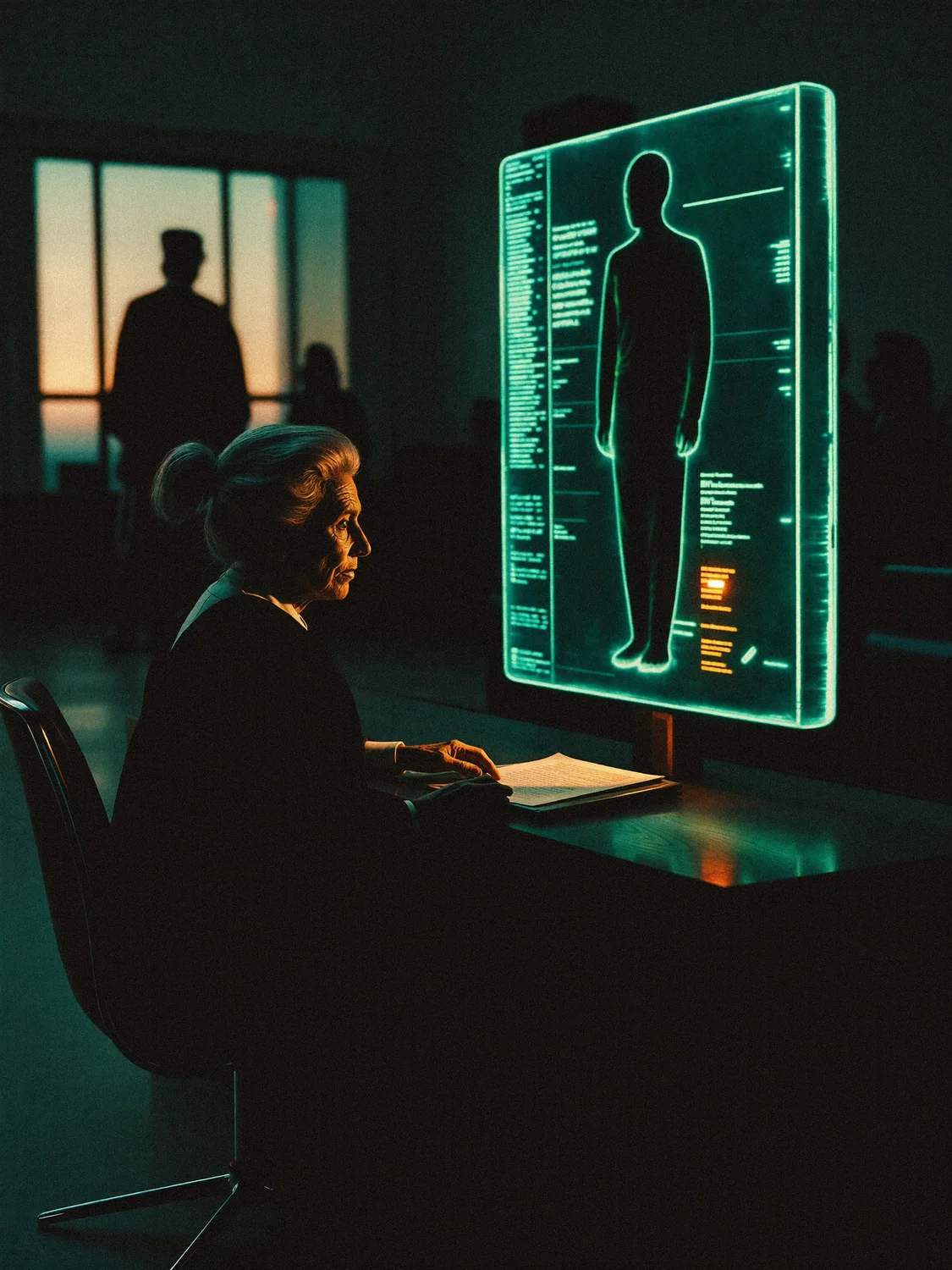
The verdict arrives at 09:04, and Judge Okonkwo has not yet read the case.
She will — that is the whole point of her, the reason her chair still exists in the year 2051 — but the system has done its overnight work and laid it out for her the way a brilliant, tireless clerk would: the facts reconciled across nine hundred hours of footage and testimony, the relevant precedent surfaced, the sentencing guidelines computed, and, crucially, the recommendation flagged in amber rather than green — human review strongly advised: defendant profile falls in a demographic band where this model has historically erred. The machine, in other words, has learned to warn her about itself.
The defendant is nineteen. The charge is aggravated fraud — a synthetic-identity scheme that drained four hundred pension accounts. The evidence is overwhelming and entirely digital: the boy's own agent, subpoenaed, testified against him in the sense that its logs did. There is no witness, no fingerprint, no doubt about what happened. The only question left is the one no algorithm is permitted to answer in her jurisdiction: what happens to him.
Okonkwo reads the file herself — all of it, slowly, while the system waits. She notes what the model flagged and what it didn't: that the boy's own identity was stolen first, at fourteen, and never repaired; that the scheme he ran was sold to him as a game by people the investigation never found; that the sentencing model, left alone, would give him nine years because nineteen-year-olds who look like him, in the training data, got nine years. She overrides it. Not the facts — the future. Rehabilitation, restitution, a supervised program, his agent placed under court monitoring. The system logs her override, her reasons, her name, and adds them, quietly, to the data that will train its successor.
This is what remains of the judge in 2051: not the finding of fact, which the machines do better, but the act of mercy, which they cannot do at all — and the responsibility, which the law will not let them hold. Okonkwo signs the order with her thumb. Somewhere, a young man's life forks.
The machine was right about everything except what to do about it. That, still, is her job.
// The science behind it
The uneasiest chapter
Of all the futures in this book, criminal justice is the one where the technology's arrival is least in doubt and most in dispute — where every capability is real, deployed, and fought over in courtrooms and streets right now. The 2021 edition catalogued the tools with an engineer's optimism: AI courts, gunshot sensors, predictive policing, digital forensics, brain-based lie detection. Nearly all of it shipped. What the original could not fully weigh — and what the mid-2020s made impossible to ignore — is that in no other domain does a technical error cost a human their freedom, and in no other domain does efficiency so easily become injustice at scale. This chapter, alone in the book, is written in a minor key. The machines came. Whether they made justice more just is the hardest question here, and the honest answer is: it depends entirely on who holds the leash.
The all-seeing street
Start with surveillance, because it is the foundation everything else is built on, and it exploded past every 2021 projection. The camera became omniscient: hundreds of millions of them worldwide, but more importantly, intelligent — no longer passive recorders reviewed after the fact, but real-time analysts that recognise faces, gaits, license plates and "anomalous behaviour" across whole cities at once. China built the template — a surveillance state of breathtaking density, social-credit experiments, the tracking of entire populations — and the technology it perfected diffused everywhere, into democracies that told themselves they would use it differently. Facial recognition moved from airports to street corners to police body cameras; live-facial-recognition vans patrol British high streets; American departments run photo databases covering most of the adult population without anyone having consented to be in them.
The reckoning came fast and cuts both ways. The wrongful arrests began making headlines — innocent people, disproportionately Black, jailed on a false facial-recognition match, because the systems that read some faces beautifully read others badly, and a machine's confident error wears the authority of objectivity. Cities banned the technology; then, as crime fears rose, quietly un-banned it. Europe's AI Act drew the sharpest line any democracy has drawn — restricting live public facial recognition, classing "predictive policing" of individuals as unacceptable risk — while the same governments carve security exceptions with the other hand. The 2051 street is, technologically, fully legible to the state. Whether that legibility serves a citizen or a regime is not a question the camera answers. It is a question the constitution answers, and this decade taught that the constitution must answer it explicitly, in law, before the camera is switched on — because after is too late.
The crime that dematerialised
While the cameras watched the street, crime left it. The signature offence of the 2020s is not the mugging but the scam: industrialised, borderless, automated fraud that stole more from ordinary people than all street robbery combined. Chapter eleven's synthetic weapons — cloned voices, deepfaked executives, AI-written lures in perfect local idiom — turned fraud into a scalable industry, run from call-centre compounds where trafficked workers (themselves victims) run romance and investment scams by the millions. The pig-butchering operation, the grandparent-voice-clone call, the fake-CEO wire transfer: these are the volume crimes of the age, and they cross every border while police forces remain stubbornly national. Cryptocurrency gave them a payment rail; AI gave them scale; and the victim is now as likely to be defrauded by a machine impersonating a loved one as robbed by a stranger.
Policing raced to follow the crime into the wires, and the same duality returned. AI is genuinely transformative for investigation: sifting oceans of financial data for laundering patterns, cracking cold cases through the DNA-genealogy revolution (the Golden State Killer caught by a distant cousin's ancestry test — a technique now standard, and a privacy earthquake still reverberating), reconstructing events from the digital exhaust every modern life emits. The crime scene of 2051 is a data-fusion problem: phones, cars, watches, doorbells, agents, all testifying. Crimes that once went unsolved for lack of a witness now have a thousand silent ones. And crimes that were never detectable — the quiet fraud, the hidden network — become visible to a pattern-matcher that never sleeps. The clearance rate rises. So does the reach of the state into the innocent life. Both are true. They are always both true.
The precrime temptation
The most dangerous idea in this chapter is the oldest science-fiction warning, and the 2020s walked straight toward it: predicting crime before it happens. Predictive policing — algorithms forecasting where crime will occur, or who will commit it — spread through the 2010s on a promise of objective efficiency and collided, in the 2020s, with a devastating critique: trained on historically biased arrest data, the models simply automated and laundered that bias, sending more police to the neighbourhoods already over-policed, generating the arrests that "proved" them right, a feedback loop wearing the mask of mathematics. The person-based versions — heat lists of "likely offenders" — were worse, tarring individuals with the statistics of their postcode. Cities that pioneered the tools began abandoning them; Europe's AI Act named individual predictive policing an unacceptable risk and banned it.
But the temptation does not die, because the underlying capability keeps growing, and the 2051 fork is stark. Down one path, prediction is confined to genuinely legitimate uses — allocating ambulances, timing patrols to place not person, flagging financial anomalies — with the individual protected by law from being judged on a forecast. Down the other lies the pre-crime state: risk scores attached to citizens, intervention before action, the presumption of innocence quietly inverted into a probability. Every tool required for the second path exists in 2026. The only barrier is the one this whole chapter keeps returning to — not technical, but political and legal: the deliberate, defended decision that some efficiencies are not worth their price. The machine can rank your neighbours by their likelihood of offending. Whether it is allowed to is the whole ballgame.
The algorithm in the dock
Deeper into the system, AI reached the courtroom itself, and here the stakes turn philosophical. Risk-assessment algorithms already advise bail, parole and sentencing across the United States — and the investigations that found them racially biased, opaque, and no better than untrained humans at prediction became the field's defining scandal, the case study in every law school. China's smart courts, AI judges and online hearings — which the 2021 essay noted admiringly — scaled to hundreds of millions of cases, a genuinely different vision of justice as throughput. The tension is now explicit and global: AI makes justice faster, cheaper and more consistent — and consistency is not the same as fairness, speed is not the same as due process, and a defendant has a right to be judged by a human who can be argued with, appealed to, and held responsible.
The settlement emerging, and the one this chapter's fiction dramatises, is a division of labour with a bright line through it. Machines for the finding of fact, the search of the record, the surfacing of precedent, the flagging of their own uncertainty — the tireless clerk. Humans for the judgment, the mercy, the discretion, and above all the accountability, because a sentence is an exercise of power over a life and power must answer to a person. Judge Okonkwo overriding the model that would jail the boy for looking like the training data is not sentiment; it is the load-bearing principle of legitimate justice: that a human being decided, and can be called to account for deciding. Automate the clerk. Never automate the judge. The 2051 question is whether societies under pressure — backlogged courts, budget cuts, fear — hold that line, or let it blur one efficient exception at a time.
The machine that carries a badge
And then the literal robocop — the title's promise. The armed autonomous officer of the movie remains, mercifully, fiction; but its components arrived in pieces. Robot dogs patrol subways and borders; drones respond to calls and chase suspects from the air ("drone as first responder" is a real program in real cities); bomb-disposal and surveillance robots are police standard. The bright red line — a machine deciding, autonomously, to use lethal force against a human — has been approached and, so far, mostly refused: a memorable municipal fight erupted when one American city briefly authorised police robots to kill, then reversed under public fury. The military, as chapter seven and later chapters detail, is far less restrained, and the autonomous-weapons debate is the darkest in this book.
For policing, the emerging norm holds a human "in the loop" of any use of force — the robot may find, follow, watch and warn, but a person must decide to harm. Whether that norm survives the first hostage crisis "solved" by an autonomous system, or the first police force that decides a machine's judgment is more defensible than an officer's, is one of the open questions of the century. The 2051 street may well be patrolled by machines. This book's fervent hope, stated plainly because the alternative is unspeakable, is that the finger on any trigger remains, always, human — and accountable.
Forensics reinvented, and its ghosts
The 2021 essay lavished attention on forensic technique, and the field did transform — though not always as advertised, and with a reckoning of its own. The genuine revolutions are real: forensic genetic genealogy, which turns a partial crime-scene DNA sample plus a consumer-ancestry database into a family tree that ends at a suspect, cleared a backlog of cold cases that had haunted communities for decades; rapid DNA machines return a profile in ninety minutes where labs once took weeks; digital forensics reconstructs a life from a seized phone. Sound-based policing matured exactly as the original predicted — acoustic gunshot sensors triangulating a shot across a neighbourhood — though the evidence on whether they actually reduce crime, versus merely generating more police dispatches to poor areas, turned equivocal enough that flagship cities cancelled their contracts. The lesson recurs: a sensor that works technically can still fail socially.
But the decade also turned a hard, overdue eye on forensic science's ghosts — the techniques admitted in courtrooms for a century that turned out to be closer to folklore than physics. Bite-mark analysis, hair-microscopy matching, some blood-spatter and even aspects of fingerprint and firearms "matching" were exposed by scientific review as far less certain than juries were told, and the wave of exonerations that followed — innocent people freed after decades, convicted on confident pseudoscience — became the field's tobacco moment. The AI twist is double-edged once more: machine learning brings genuine statistical rigour to disciplines that ran on expert intuition, attaching real error rates to claims that once pretended to have none — and simultaneously introduces new black boxes, algorithms whose "match" a defendant cannot cross-examine. The 2051 forensic standard being built now demands what the twentieth century's never did: quantified uncertainty, open validation, and the right to interrogate the method. Justice learned, expensively, that a confident expert and a confident algorithm can be wrong in exactly the same way — and that certainty, unearned, is how the innocent go to prison.
Interrogating the brain
The 2021 edition's most futuristic passage imagined the polygraph reborn — brain-scanning, memory-detection, motion-capture lie detection admitted as court evidence. The 2020s advanced the science and, encouragingly, mostly held the legal line. Functional brain imaging can, in laboratory conditions, distinguish recognition from unfamiliarity — the "concealed information test" that asks not are you lying but does your brain know this weapon — and AI applied to voice, micro-expression and physiology produces ever-more-confident deception scores. Commercial "AI lie detectors" are already sold for border screening and job interviews, which is precisely where the danger concentrates: not in the courtroom, which mostly still refuses them, but in the unregulated margins where a machine's verdict on your honesty carries no right of appeal.
The principled objections have, so far, largely prevailed in law, and they are worth stating because they will be tested repeatedly toward 2051. The mind has a special status: the right against self-incrimination, the freedom of the interior life, the simple scientific fact that these tools remain unreliable enough that a false positive is a catastrophe. A society that can read guilty knowledge from a brain scan has acquired a power its legal traditions were explicitly built to deny the state. This book's position is unambiguous: cognitive liberty — the freedom of one's own mind from involuntary inspection — is a right the twenty-first century must name and defend as fiercely as the twentieth defended free speech, because the technology to violate it is arriving before the law that forbids it. The interior life was the last private place. It must not become evidence.
The prison, reconsidered
Punishment, too, is being redesigned — and the fork is as sharp as anywhere in this chapter. Technology enables a genuinely more humane vision: electronic monitoring and GPS supervision that let non-violent offenders serve sentences at home, in work, with family, at a fraction of prison's cost and cruelty; VR-based rehabilitation and therapy programs; AI tutoring (chapter five) reaching the incarcerated, whose recidivism falls sharply with education. The Nordic model — prison as rehabilitation, dignity as policy, the lowest reoffending rates in the world — has data on its side, and the tools now exist to extend its logic widely. Restorative justice, victim-offender mediation, and treatment-over-incarceration for addiction and mental illness all gain from better technology and better evidence.
But the same tools enable the opposite: the surveillance sentence, the ankle-monitored underclass, the "digital prison" that follows a person into a life of permanent, automated supervision — punishment without walls but also without end, and disproportionately imposed on the same populations the biased algorithms already target. The dystopian version is not incarceration but perpetual conditional freedom, monitored by machines, revocable by a risk score. Which future arrives depends, once more, not on the technology but on the philosophy behind it: is the goal to rehabilitate a citizen or to manage a threat? The 2051 justice system will have unprecedented power to do either at scale. The tools are neutral. The intent is everything, and the intent is a choice a society makes — and remakes — in daylight, or surrenders in fear.
Justice for the many
One promise of this chapter's technology deserves its due, because the book's optimism is earned as often as its warnings: AI is, at last, cracking the access-to-justice crisis that left most ordinary people effectively locked out of the law. Legal help was a luxury; the majority of civil legal needs — eviction, debt, benefits, divorce, immigration — went unmet because lawyers cost more than the stakes could justify. Large language models changed the arithmetic overnight. AI legal assistants now draft the pleading, explain the notice, populate the form, and walk a frightened tenant through a hearing — the same leapfrog that banked and doctored the underserved, now lawyering them. Courts experiment with plain-language AI guides; the self-represented, who are the majority in many civil courts, finally have a competent helper.
The cautions are real — hallucinated case citations that got lawyers sanctioned, the risk of a two-tier system where the poor get the bot and the rich get the human, the unauthorised-practice-of-law fights — but the direction bends toward justice. When legal knowledge stops being a scarce, hoarded, billable commodity and becomes a utility anyone can query, the balance of power between the individual and the institutions that act on them shifts, for the first time in centuries, toward the individual. The same intelligence that lets the state watch everyone also lets everyone read the law that is supposed to protect them. In this darkest chapter, that is the light: the machine that empowers the powerful can, if we insist on it, empower the rest.
The end of the alibi, the end of privacy
Underneath every section runs the same tectonic shift: the disappearance of the unobserved life. Between ubiquitous cameras, phone-location trails, car telemetry, purchase records, DNA databases and the testifying agents of chapter three, the 2051 citizen leaves a continuous, permanent, searchable record of their existence. For justice, this is double-edged past the point of paradox. The guilty are far harder to hide: the alibi dies when your phone, your car and your watch all place you at the scene; wrongful convictions fall as DNA and digital records exonerate the innocent (the innocence-project revolution, now supercharged). But the same total record means the state — or whoever holds the data — knows everything about everyone, always, and the presumption of privacy that democratic justice quietly depended on is simply gone.
The reckoning this forces is the century's, not just this chapter's: in a world where everything is recorded, the protection of the innocent can no longer rest on obscurity. It must rest on rules — hard law about what may be collected, retained, searched and used; who may see it and when; and what a free society refuses to know about its citizens even though it could. The technology has abolished practical privacy. Only politics can rebuild it as a right. The camera sees all. The question the 2020s handed to 2051 is not whether we can watch everyone. We can. It is whether we choose to build a society worth being watched in, governed by people we can still hold to account.
The border as laboratory
There is a place where every technology in this chapter is deployed first, tested hardest, and restrained least — the border. Migration politics hardened across the democratic world through the 2020s, and the frontier became the proving ground for justice-tech's most aggressive forms: biometric mass enrolment of asylum seekers, AI "risk" scoring of visa applicants, algorithmic asylum triage, drone and sensor surveillance of crossings, and the "smart wall" of towers and analytics that replaced concrete with computation. The border is where societies grant themselves permission to do what they forbid at home — to surveil without suspicion, to judge by algorithm, to detain on a score — because the subjects are non-citizens with the fewest rights and the weakest voice. Which is exactly why it matters to the rest of us: the border is not a walled-off exception but a laboratory, and its tools have a long history of migrating inward, from the frontier to the city, from the foreigner to the citizen. The surveillance normal of 2051 is being calibrated, right now, on the people least able to refuse it. A society that wants to know what its justice technology will eventually do to everyone should watch what it does, today, to the migrant.
The road to 2051
Surveillance becomes total; oversight becomes the battleground. Every street legible, every transaction traceable — and the entire fight moved to law: what may be watched, retained, matched and used. The free societies of 2051 are the ones that regulated the camera before switching it on.
Investigation is transformed; the alibi is dead. Data fusion solves the solvable and much of the unsolvable; DNA genealogy and digital forensics make guilt hard to hide and innocence easier to prove — at the cost of a privacy that only law can restore.
Prediction is permitted for places, forbidden for persons — or it isn't, and that single legal choice separates the safety-optimised city from the pre-crime state. Every tool for both exists; only the constitution decides which gets built.
The judge survives, the clerk is automated. Machines find fact and surface precedent and flag their own bias; humans hold judgment, mercy and accountability. The bright line — automate the clerk, never the judge — is the difference between justice with better tools and mere efficient punishment.
And the trigger stays human. Machines may patrol, watch, and warn; the decision to harm a person remains a person's, answerable to law. This book's least negotiable hope, in its least comfortable chapter: that the most consequential judgments of justice are never handed to something that cannot be held responsible for making them.
// 2021 → 2026 verdict
2021 verdict: Probability 70/100 — AI courts, sensors, predictive policing, digital forensics. 2026 reality: it all arrived, and revealed that in justice, capability is the easy part. The cameras see, the algorithms sort, the alibi is dead — and the wrongful arrests, the automated bias and the pre-crime temptation proved that the hard question was never can we, but should we, and who decides, and who answers when it's wrong. Robocop 2.0 exists. Whether it serves justice or merely enforces it depends, entirely, on the humans who keep — or surrender — the final word.
This chapter was rewritten in 2026 by Brice × Claude Fable5. Read the original 2021 edition — written entirely by humans, published one year before ChatGPT existed.